

GDPR-Compliant Shopify Email Popups: What EU Merchants Need to Check (2026)
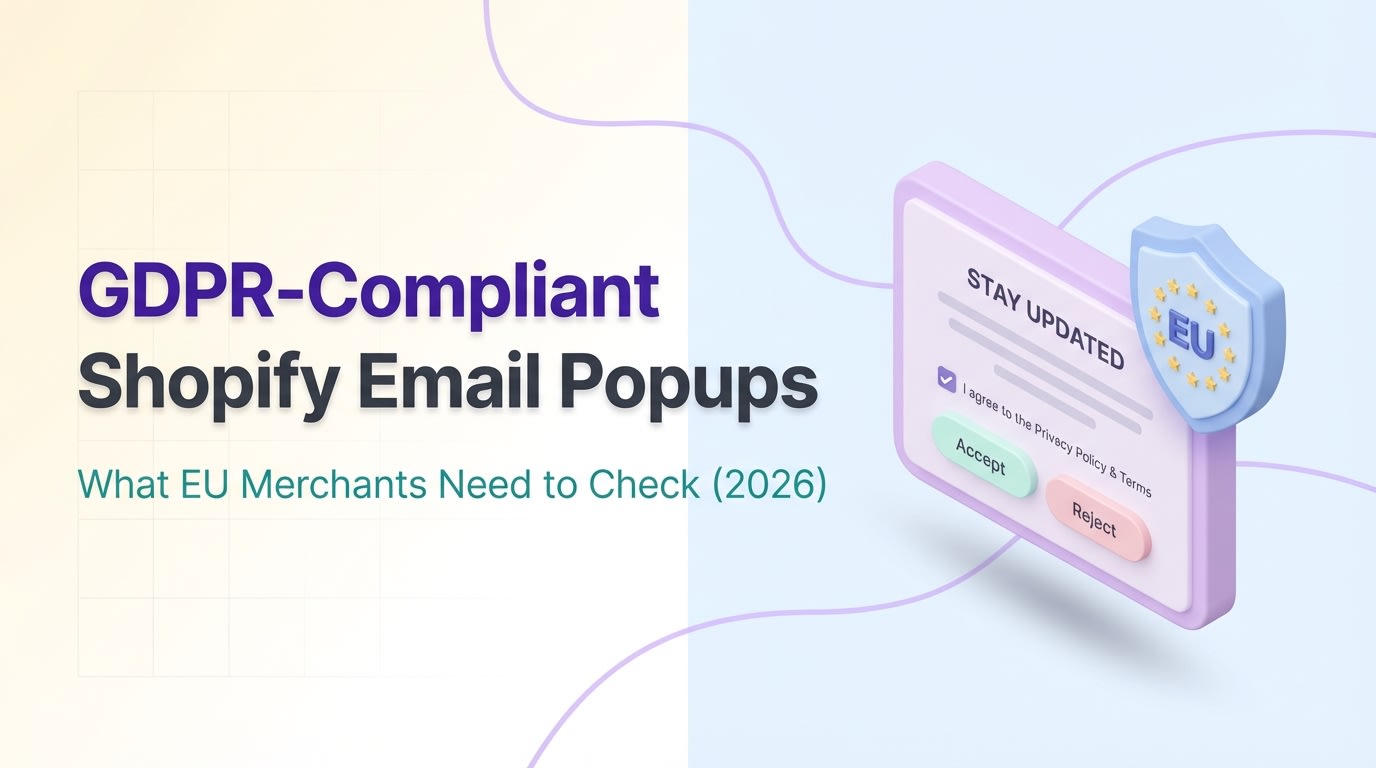

There is a quiet problem frustrating Shopify merchants right now: the Consent-Performance Paradox. You install a heavy cookie banner to avoid legal fines, and suddenly your Core Web Vitals tank. Your pages jump around, your Cumulative Layout Shift (CLS) spikes, and your organic rankings start to slip.
With enforcement tightening around shopify popup gdpr compliance 2025 standards, having a properly configured consent management platform (CMP) is mandatory. Between the rollout of Google Consent Mode v2 and stricter multi-region laws, merchants need a technical setup that protects user data and store performance simultaneously.
We are going to break down exactly how to navigate 2025's privacy requirements. You will learn how to set up compliant cookie banners, handle email lead-gen popups, and implement crucial CSS tweaks to keep your storefront lightning-fast.
Let's get started!
I. Overview of 2025 Shopify Privacy Requirements

Balancing compliance with performance is the primary challenge for merchants in 2025.
Privacy rules are changing rapidly. Here is exactly what you need to know about the current legal landscape before adjusting your storefront.
1. Google Consent Mode v2 is Now Mandatory
Google Consent Mode v2 became a strict requirement in March 2024 for European traffic using Google Ads. Going into 2025, it dictates your entire ad attribution strategy. A basic Accept All cookie banner shopify app no longer cuts it. Your consent management platform must now communicate advanced consent signals (specifically ad_user_data and ad_personalization) back to Google. Failing to send these signals means you lose conversion tracking data for your European buyers completely.
2. Native Shopify Privacy App vs. Third-Party CMPs
Does Shopify have a built-in GDPR popup? Yes, the native Customer Privacy app handles basic needs. However, for advanced script blocking, granular cookie categorization, and seamless Google Consent Mode v2 integration, you need a dedicated GDPR app for shopify like CookieYes or Pandectes. Relying purely on theme-built banners leaves dangerous gaps in your compliance framework.
3. Multi-Region Complexity via Shopify Markets
Showing a strict GDPR banner to US customers actively hurts your conversion rates. Modern compliance utilizes Shopify Markets geolocation to serve entirely different experiences based on IP addresses. You need explicit opt-in banners for the EU and UK to meet Schrems II regulations. For California shoppers, you only need subtle opt-out links to satisfy the CCPA. Regional mapping is crucial for maintaining high global sales.
II. 6 Steps to Set Up a Compliant (and Fast) Shopify Popup
Building a fully compliant system means configuring your apps, tracking pixels, and email marketing properly. Here is your technical blueprint for 2025.
1. Integrate Google Consent Mode v2 with Shopify Pixels

Proper GCM v2 setup ensures your ad campaigns don't lose conversion data.
Getting your Google Consent Mode v2 Shopify guide right is critical for your ROAS. If you run Google Ads, failing to pass consent signals means losing attribution data entirely.
Here's how to implement it:
- Select a certified CMP: Ensure your chosen app supports IAB TCF 2.2 standards.
- Enable native pixel tracking: Go to your Shopify Customer Events and grant your CMP app permission to intercept the standard web pixels.
- Verify tag firing: Use Google Tag Assistant to verify that
ad_storagedefaults to denied before the user interacts with your banner.
This prevents unauthorized tracking while allowing Google's modeling to recover lost conversion data effectively.
2. Balance the Accept and Reject Buttons
Regulators are cracking down heavily on deceptive design in 2025. Hiding the Reject All button or making it a different, less visible color than the Accept All button violates explicit consent rules directly.
Here's how to implement it:
- Equal styling: Ensure both buttons have the exact same visual weight, size, and contrast on your popup.
- Granular settings: Provide a clearly visible Manage Cookies link for users who want to pick and choose their tracking preferences.
- No pre-ticked boxes: Non-essential cookies (analytics and marketing trackers) must default to un-ticked.
3. Secure Email Marketing Popups with Double Opt-In
Compliance goes beyond cookies. You also need to manage how you collect customer emails. A standard discount popup without explicit consent checkboxes violates GDPR data processing rules.
Here's how to implement it:
- Add a consent checkbox: Include an unchecked box stating that the user agrees to receive promotional emails and accepts the Privacy Policy.
- Enable Double Opt-In: Configure your email app to send a confirmation email before adding subscribers to your marketing list.
- Use a compliant builder: Tools like Fordeer Sales Pop Up help you design high-converting, legal lead-gen forms seamlessly.
Pro Tip: If you want to create beautiful forms without annoying customers, check out our guide on Pop-Up UX Design: Typical Errors and Recommended Alternatives to maximize conversions securely.
4. Accurately Map Non-Essential Cookies
Not all cookies require consent, but mixing them up causes immediate legal headaches. You must distinguish between cookies that run your store (essential) and cookies that track behavior (non-essential).
Here's how to implement it:
- Run a scanner: Use your consent management platform to scan your live domain for all active scripts.
- Categorize properly: Classify the Shopify session cookie as Strictly Necessary. Categorize your Meta Pixel, TikTok Pixel, and Google Analytics as Marketing or Analytics.
- Test the block: Clear your browser cache, visit your site, and inspect the network tab to ensure marketing scripts do not fire until you click Accept.
5. Configure Geolocation via Shopify Markets

Targeted compliance prevents you from annoying customers in regions without strict cookie laws.
A blanket privacy popup for global traffic creates unnecessary friction for shoppers in regions without explicit consent requirements.
Here's how to implement it:
- Sync with Markets: Link your privacy app directly to your active Shopify Markets settings.
- Set EU/UK rules: Force an explicit consent banner where users must click accept to be tracked.
- Set US rules: Implement a subtle footer link for Do Not Sell or Share My Personal Information to satisfy CCPA, keeping the main screen clear.
6. Build a Data Request (DSAR) Workflow
Under current privacy laws, customers have the right to request all data you hold on them. Failing to provide or delete data within 30 days results in direct penalties.
Here's how to implement it:
- Create a dedicated page: Add a Data Subject Access Request form to your storefront footer.
- Document your process: Create a standard operating procedure to export a Shopify gdpr compliance 2025 pdf containing the customer's complete order history and profile data.
- Automate erasure: Learn how to use Shopify's native Erase personal data function within the customer profile dashboard to fulfill right-to-be-forgotten requests instantly.
III. Optimizing Your GDPR Popup for Core Web Vitals
Solving the legal side is only half the battle. Now you must fix the Consent-Performance Paradox by ensuring your banner does not destroy your store speed.
1. The Cumulative Layout Shift (CLS) Problem
Most third-party privacy apps inject their banner via JavaScript after the main HTML has loaded. When the banner suddenly renders at the top or bottom of the screen, it pushes all your page content down. Google measures this as Cumulative Layout Shift (CLS).
A high CLS score frustrates mobile shoppers who accidentally click the wrong button. It also damages your search rankings. To protect your organic traffic, you need to understand how pop-up usage impacts your SEO and Google's criteria for pop-up display to stay in compliance with search guidelines.
2. Reserving CSS Space to Prevent Layout Shifts
To prevent CLS entirely, you must tell the browser exactly how much space the cookie banner will take up before the JavaScript loads.
Here's how to fix it: Inject a small CSS snippet into your theme.liquid file. If your banner is 80px tall on mobile, wrap the banner's container in a div and apply a min-height: 80px; property to it. This reserves a blank space on the screen instantly. When the app's script finally loads the banner, it fills the pre-reserved space without pushing the rest of your storefront down.
3. Smart Script Loading and Execution
Heavy consent apps often block the main thread, causing a slow First Input Delay (FID) or Interaction to Next Paint (INP). This makes your store feel sluggish and unresponsive.
Here's how to fix it: Avoid installing multiple privacy apps simultaneously. Choose one lightweight app built specifically for Shopify's modern architecture. Additionally, ensure your theme loads the CMP script asynchronously using the async or defer tags. This allows your hero images and Add to Cart buttons to load and become clickable while the privacy logic runs quietly in the background.
IV. Conclusion
So there you go—getting your store ready for strict 2025 privacy laws does not have to mean sacrificing your user experience or page speed. By implementing Google Consent Mode v2, accurately categorizing your scripts, and applying CSS layout fixes, you can protect your business legally while keeping your storefront incredibly fast.
You do not have to choose between legal safety and high conversion rates. Start by auditing your current popup today, balance your consent buttons visually, and configure your Shopify Markets geolocation rules.
Follow the Fordeer Team for more useful updates!
- Install Fordeer Apps for Free
- Get immediate assistance by chatting with us
- Join Fordeer Commerce Community for fresh app updates, expert tips, and private deals.