

VAT Invoice Requirements in France: Shopify Checklist (2026)


Imagine getting audited by French tax authorities and discovering you owe €15 for every single invoice missing a mandatory detail. Under the French General Tax Code (CGI), these penalties compound up to 25% of your invoice value. If you sell into France, a standard Shopify receipt will not keep you safe.
Navigating VAT invoice requirements in France means dealing with strict rules around SIRET numbers, translations, and complex reverse charge phrasing. Treating a French customer like a domestic one is a massive financial risk.
In this guide, we break down what makes French invoices legally binding. You will get the definitive compliance checklist and learn to automate your invoicing. Plus, we look at the fast-approaching 2026 Factur-X mandate to future-proof your store. Let's get started!
I. Overview of French Tax Compliance

French tax compliance requires strict adherence to mandatory mentions to avoid heavy fines.
1. The Strict Reality of French Invoicing
The General Directorate of Public Finances (DGFiP) views invoices as strict legal tax documents, not just commercial requests. Standard eCommerce platform receipts often fail French audits by default because they lack specific legal references. Relying purely on out-of-the-box templates leaves a dangerous gap in your compliance armor.
2. The Toubon Law (Language Requirements)
The Toubon Law mandates French in official business documents. You can legally issue invoices in English for international trade. However, French tax authorities have the right to demand a certified French translation during an audit. Proactive dual-language formatting saves you massive time and legal fees.
3. The Cost of Getting It Wrong
Mistakes are expensive. The DGFiP imposes a €15 penalty per missing mention on every single invoice. Worse, you run the risk of losing the 50% tax credit if intra-community VAT numbers are missing. If you process 1,000 orders monthly, those fines quickly snowball into business-threatening debt. This impacts both your liability and your French buyer's ability to reclaim VAT.
II. The 15-Point French Invoice Checklist
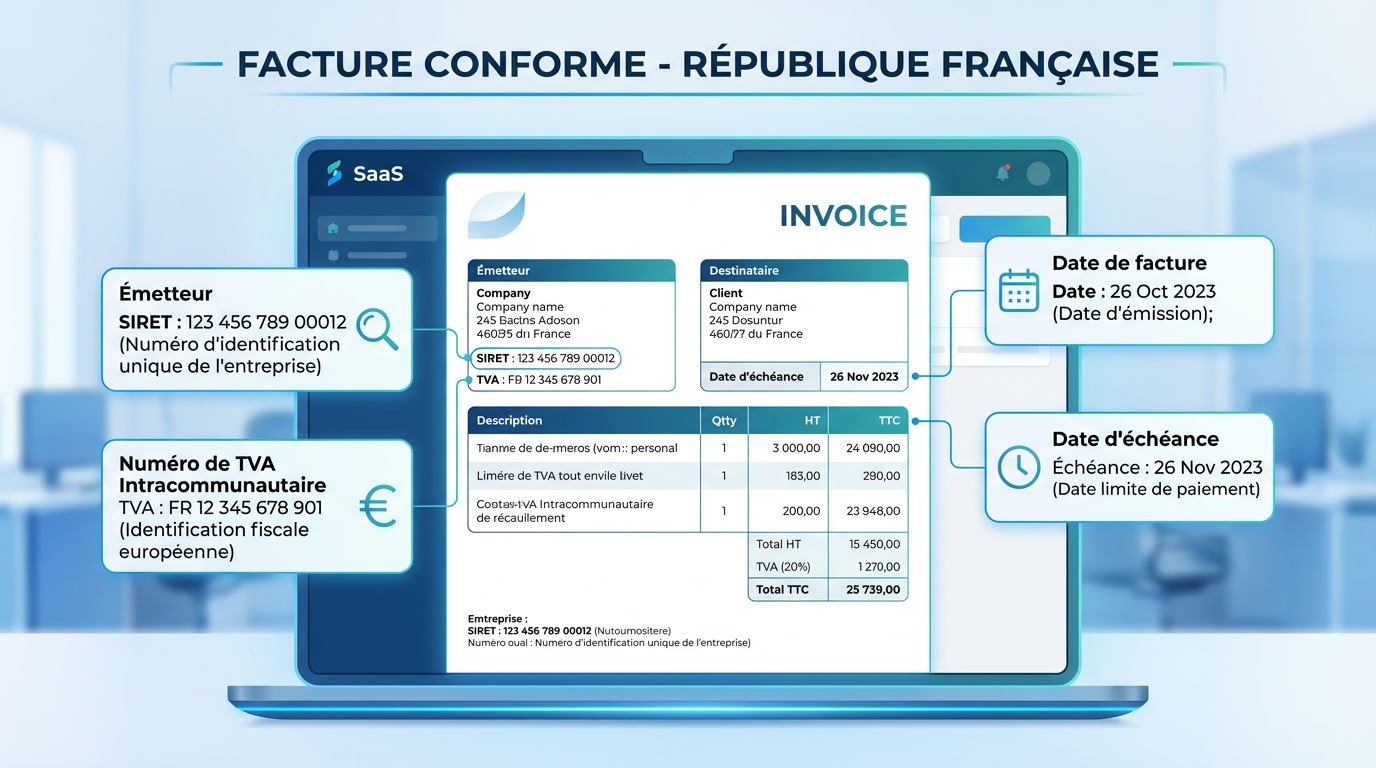
A complete breakdown of mandatory fields required by the French General Tax Code.
The French Commercial Code requires highly specific entity identification on every transaction. Here is your definitive checklist to ensure your store meets the legal standard.
Standard Transaction Details:
- Date of Issue & Delivery: Explicitly separate the invoice issue date from the exact goods delivery or service completion date.
- Unique Invoice Number: You need a strictly sequential, gapless numbering system (e.g., 2026-001, 2026-002).
- Detailed Line Items: State the exact quantity, precise unit price excluding VAT, and the specific nature of the goods or services sold.
Identity and Registration (The French Specifics):
- SIREN/SIRET Numbers: These are the 9 or 14-digit business identification numbers unique to French entities.
- RCS Registration: Include the specific Trade and Companies Register city (e.g., RCS Paris).
- Legal Form & Capital: For companies, you must mention the business structure (SARL, SAS) and the share capital amount.
- Intra-community VAT Numbers: Include both your full supplier VAT ID and the customer's verified VAT ID.
Tax Calculation Breakdown:
- Applicable VAT Rates: Clearly distinguish between 20% (standard), 10%, 5.5%, or 2.1% if you sell mixed goods.
- Total Amount Excl. VAT (HT): Your Hors Taxes total must be clearly separated.
- Total VAT Amount: Show the exact tax value calculated for the transaction.
- Total Amount Incl. VAT (TTC): End with the Toutes Taxes Comprises final total.
Missing even one of these details invalidates the document in the eyes of the DGFiP.
III. 5 Strategies to Automate Your French VAT Compliance
Automating your compliance is the only way to scale without constantly looking over your shoulder for tax auditors. Here is how to configure your systems to handle French buyers flawlessly.
1. Nail the Exact Reverse Charge Wording
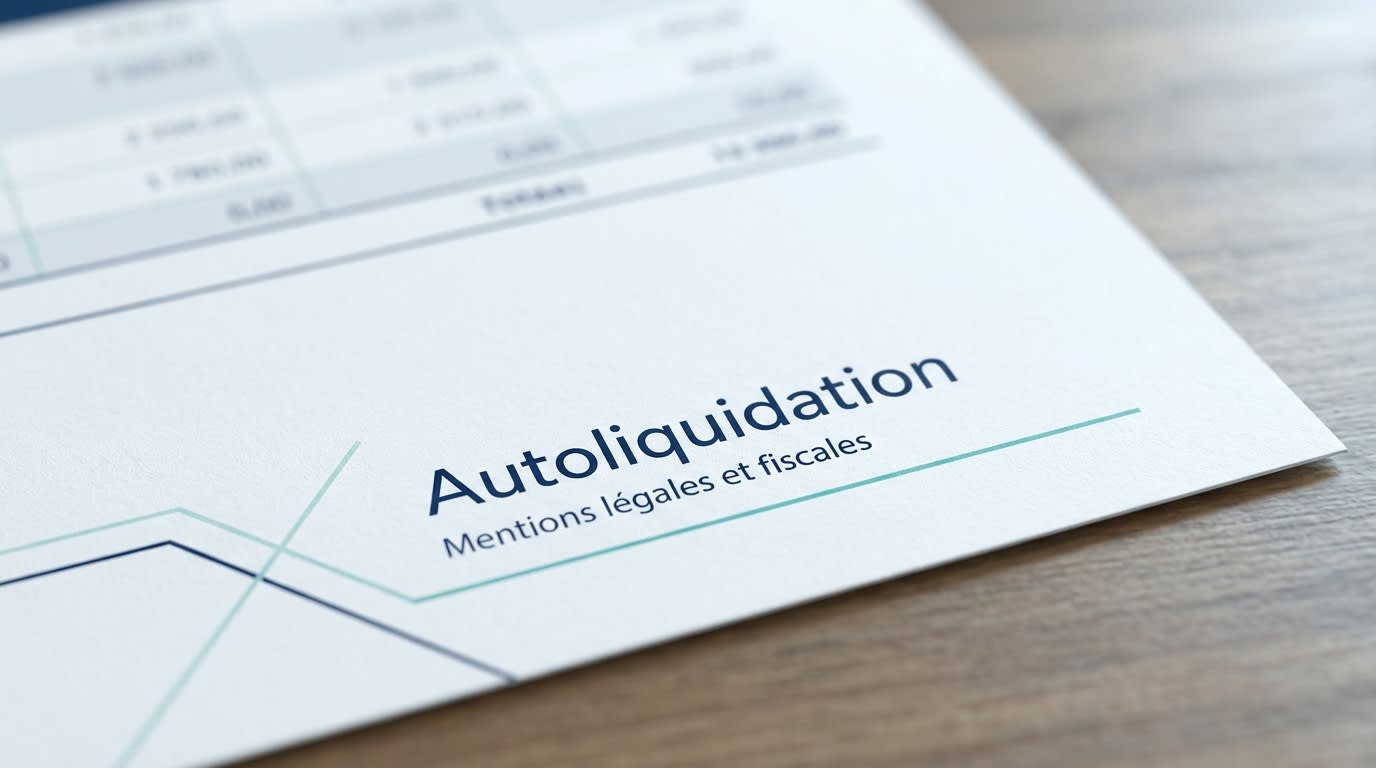
Using the correct legal phrasing for cross-border B2B transactions is non-negotiable.
When selling B2B across EU borders into France, you do not charge VAT, but you must legally state why. A blank VAT line is a red flag.
Why this matters: Using vague terms like Tax exempt fails a French audit. You must use the precise legal terminology. For deeper context on EU regulations, read our complete guide on Understanding VAT Compliance in the EU.
Here is how to implement this:
- Use the correct phrase: Ensure your invoice template automatically outputs Autoliquidation or TVA auto-liquidée when the reverse charge mechanism applies.
- Cite the directive: Add a footer rule that prints: Exonération de TVA, article 262 ter I du CGI or the EU equivalent Article 138 of Directive 2006/112/EC.
- Condition your templates: Set up your PDF generator to only show this text when a valid B2B VAT number is present and the billing country is France.
2. Automate SIREN and VIES Validation
Accepting a typed VAT number at face value is incredibly dangerous. If invalid, you become liable for the uncollected 20% VAT.
Why this matters: The French tax authority cross-references B2B claims against the European VAT Information Exchange System (VIES).
Here is how to protect your store:
- Capture SIRET/SIREN: Add custom registration fields to your checkout specifically for French business customers.
- Live validation: Use tools that ping the VIES database in real-time before allowing the customer to check out without tax.
- Document the proof: Ensure your invoicing app stores the VIES consultation number alongside the invoice generation log. This serves as proof of compliance at the time of sale.
3. Differentiate Between B2B and B2C Invoicing Logic
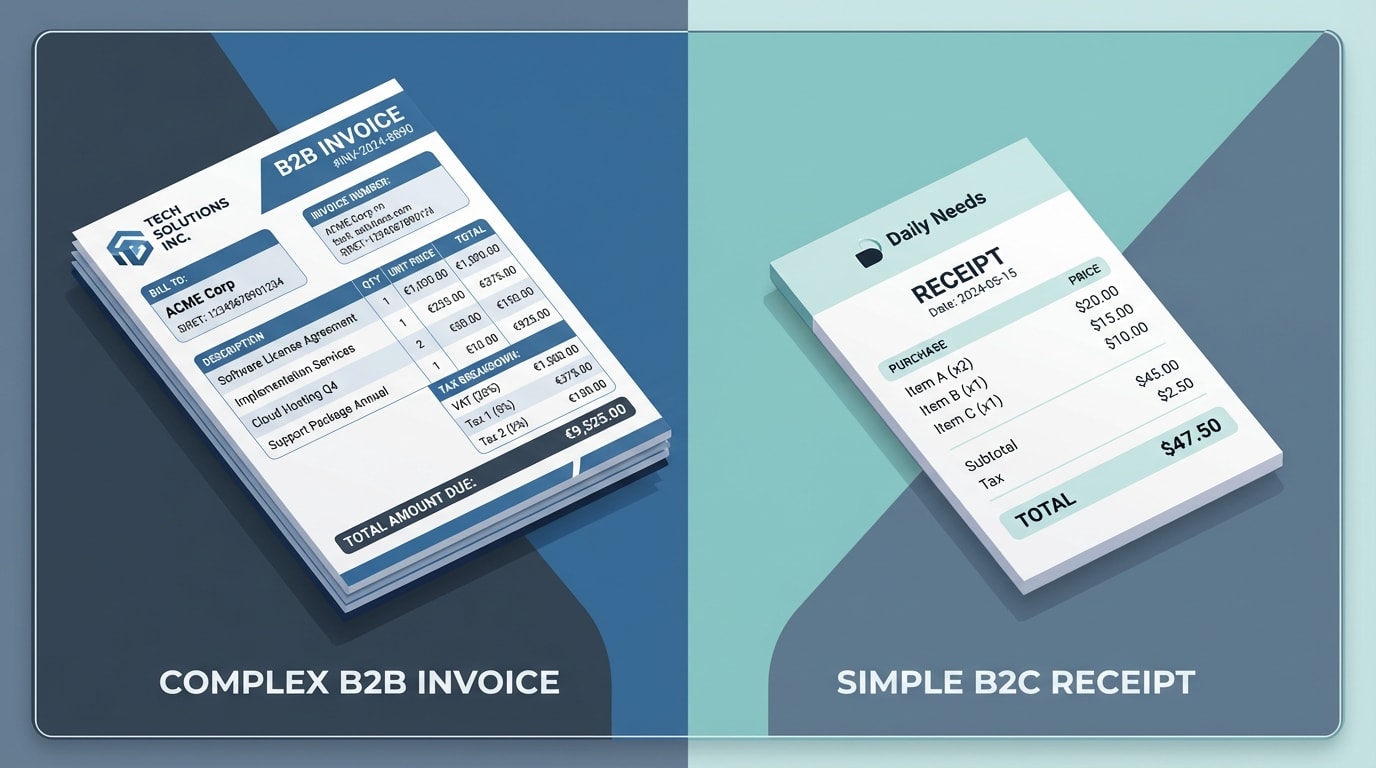
Your store must dynamically adjust its invoice output based on the customer type.
French regulations treat an individual consumer (B2C) vastly differently than a registered business (B2B). Cluttering a B2C invoice with B2B legal jargon confuses retail customers. Conversely, giving a B2B client a simple retail receipt blocks their accounting department from processing payment.
Why this matters: If you need help structuring these globally, review our insights on Global VAT Compliance: A Guide for Shopify Sellers.
Here is how to set this up:
- Set up customer tags: Tag accounts in your eCommerce platform based on their business registration status.
- Create conditional templates: Design one template for consumers (focusing on clear return policies and TTC pricing) and a secondary template for businesses (focusing on SIRET, HT/TTC breakdowns, and payment terms).
- Automate routing: Use a smart PDF generator that detects the presence of a company name or VAT ID to automatically trigger the B2B template.
Pro Tip: For French B2B invoices, you must also legally state the penalty rate for late payments (usually 3x the legal interest rate) and the fixed €40 indemnity for recovery costs.
4. Implement Dual-Language Templates for the Toubon Law
As mentioned earlier, language barriers can trigger immediate audit failures.
Why this matters: Your support team speaks English. However, the French tax inspector reviewing your client's accounts demands French.
Here is how to fix it:
- Use bilingual labels: Instead of just Invoice, use Invoice / Facture.
- Translate line items: Ensure your product variants have localized names in your feed whenever possible.
- Standardize tax terms: Always include the French acronyms (TVA for VAT, HT for Excl. Tax, TTC for Incl. Tax) alongside your native language equivalents.
5. Upgrade to a Compliance-First PDF Generator
Manual data entry for cross-border invoices guarantees human error and €15 fines.
Why this matters: Basic order printers just take a snapshot of your checkout screen. You need software that understands complex tax logic.
Here is what you need to do:
- Audit your current app: Check if your tool allows for custom tax overrides, conditional formatting, and custom metafield injection (like SIRET numbers).
- Look for automation: The right tool seamlessly pulls data from Shopify, applies compliance rules, and emails the PDF directly to the client. You can easily achieve this with Fordeer PDF Invoice Generator.
- Ensure secure archiving: French law requires you to keep invoices safely archived for 10 years. Ensure your app offers reliable, unalterable PDF generation.
IV. Beyond PDFs: Preparing for Factur-X and 2026
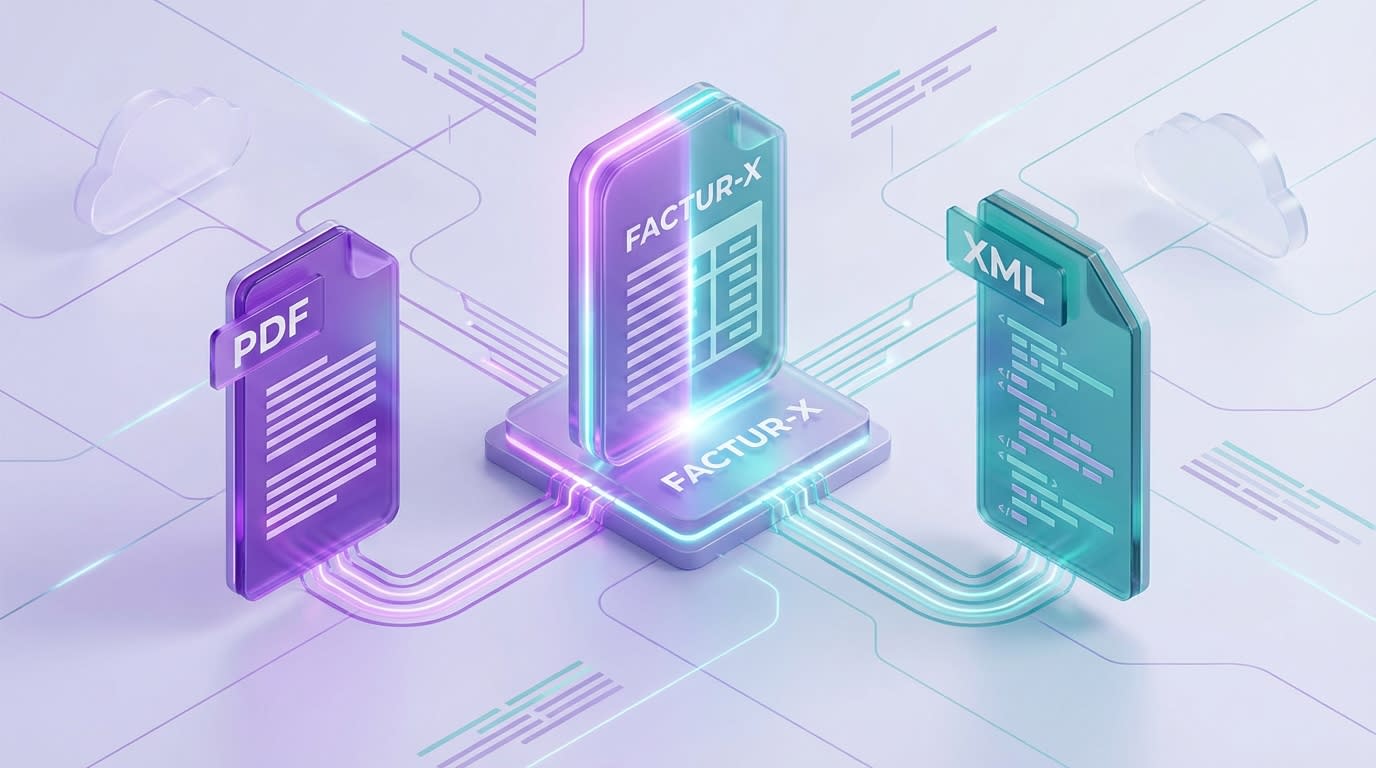
Factur-X is a hybrid format containing both a human-readable PDF and machine-readable XML data.
Most merchants believe generating a visually appealing PDF ends the compliance journey. However, the French invoicing landscape is undergoing a massive technical revolution.
The E-Invoicing Mandate
Starting in a rollout approaching September 2026, the French government is mandating B2B e-invoicing and B2C e-reporting. Emailing a standard PDF will no longer be legal for domestic B2B transactions. Cross-border sellers will need to understand exactly how data flows into the French tax ecosystem to remain compliant.
Enter Factur-X (PDF/A-3)
The secret to this transition is Factur-X. This is not new software, but a specialized hybrid file format.
- On the outside, it looks exactly like a standard PDF that a human can easily read and print.
- Hidden inside the file is an embedded XML data layer that accounting software and the French tax portal (Portail Public de Facturation) can read instantly.
What You Need to Do Now
You do not need to panic today, but you must align with technology partners preparing for this shift. The national Directory (Annuaire) will soon use SIREN numbers to automatically route these XML-embedded invoices to the correct buyer's platform.
When choosing your invoicing infrastructure today, ensure your provider is aware of European e-invoicing mandates. Transitioning to a smarter generation tool now ensures you will not be scrambling when the 2026 regulations officially go live.
V. Conclusion
So there you go. Navigating VAT invoice requirements in France does not have to be a legal nightmare. By understanding the mandatory mentions, utilizing the correct reverse charge wording, and preparing for the upcoming Factur-X mandate, you protect your business from unnecessary fines and lost tax credits.
You do not have to tackle everything manually. With the right automated workflows, generating fully compliant, dual-language invoices for your French customers happens instantly behind the scenes. Start by auditing your current invoice template, and gradually apply these specific legal mentions. This leaves you free to focus on growing your store.
Follow the Fordeer Team for more useful updates!
- Install Fordeer Apps for Free
- Get immediate assistance by chatting with us
- Join Fordeer Commerce Community for fresh app updates, expert tips, and private deals.